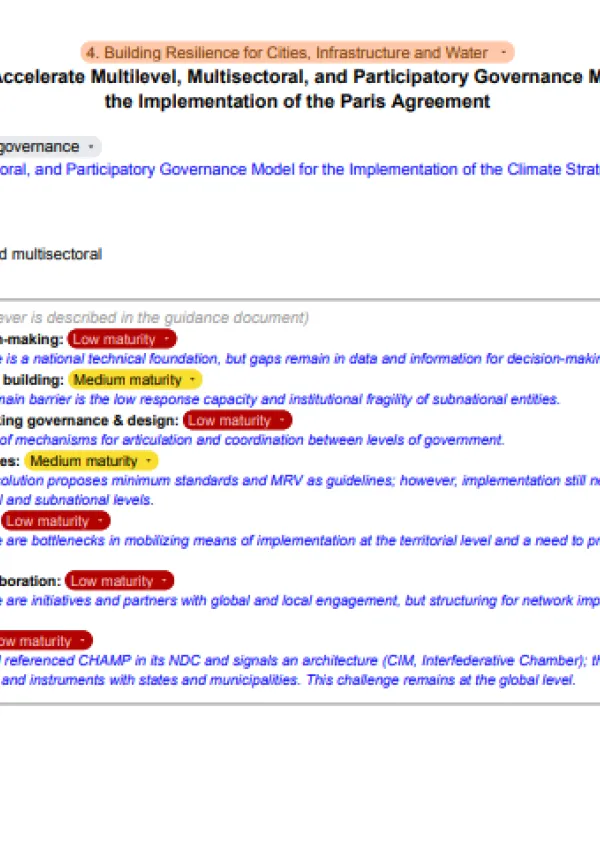
Plan to Accelerate Multilevel, Multisectoral, and Participatory Governance Model for the Implementation of the Paris Agreement
The central objective of this Plan to Accelerate the Solution (PAS), launched at COP30 in Belém, Brazil, by the UNFCCC with CHAMP as the host, is to secure national governments’ commitment to integrating subnational entities into climate strategies, fostering coherence between local actions and international targets.
A Multilevel, Multisectoral, and Participatory Governance Model for the Implementation of the Paris Agreement can be defined as a strategic coordination framework that brings together different levels of government – national, state, and municipal – and key sectors such as health, urban planning, food security, agriculture, waste, water and sanitation, mobility and energy. It establishes an integrated agenda for climate action that acknowledges the importance of both social and institutional participation. The model ensures that climate policies are designed collaboratively and inclusively, while remaining consistent with global commitments under the UNFCCC.
The PAS is structured around four key levers: Risk-informed decision-making, knowledge and capacity-building, public and private financing, and inclusive, multilevel governance that ensures social participation. It also sets clear implementation targets: By 2028, 100 national climate plans and NDC implementation strategies should formally include multilevel governance mechanisms, increasing to 120 plans by 2030.